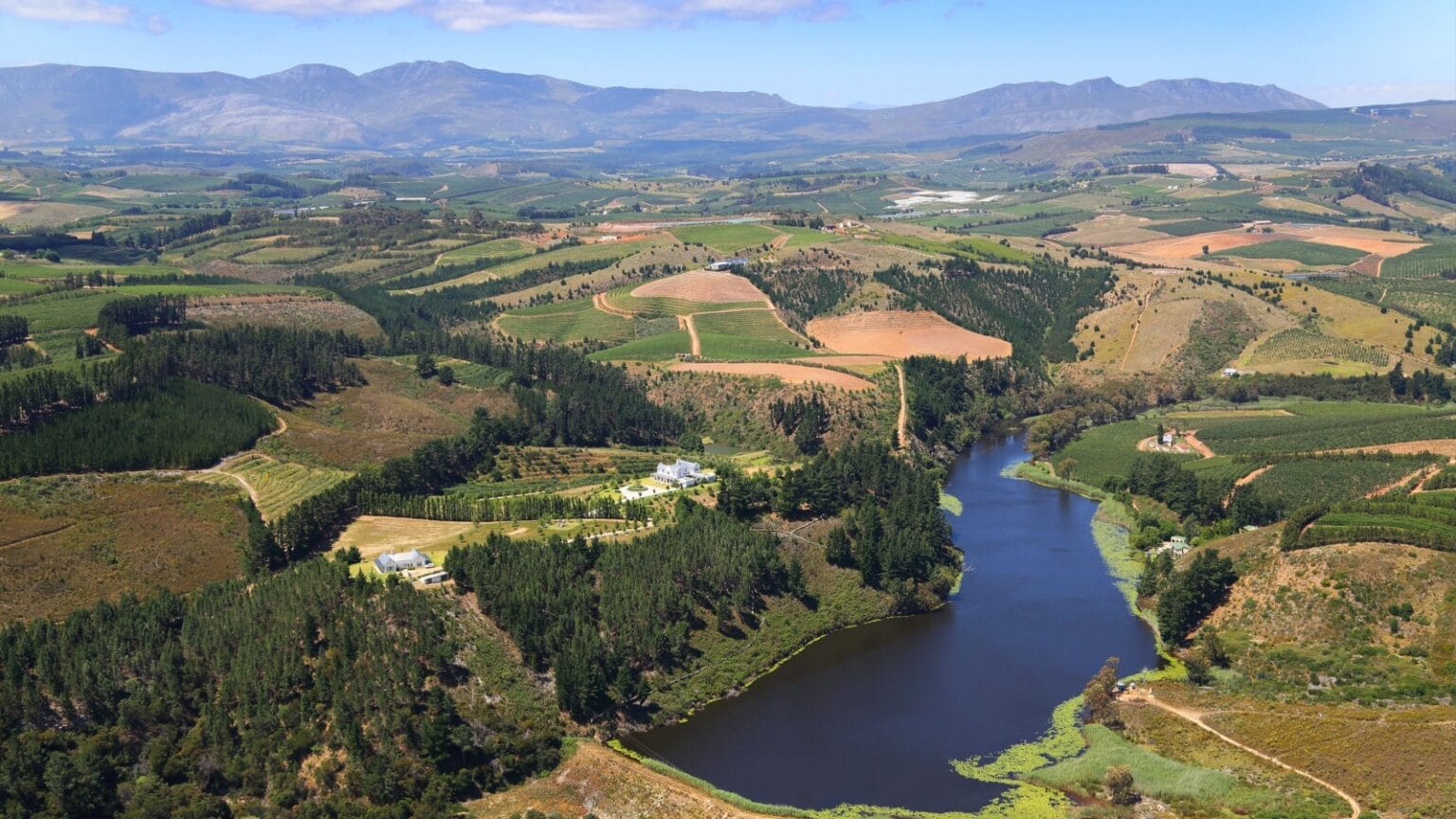
The Western Cape town of Grabouw has emerged as a leading testing ground for AI-driven agricultural technology in South Africa, with drone-based spectral imaging, AI-powered irrigation and crop monitoring tools deployed across what is the largest single source of exported fruit in southern Africa.
Located about 65 kilometers east of Cape Town, Grabouw is the commercial hub of the Elgin Valley. The region has a deep agricultural history, with the area originally inhabited by Khoi pastoralists and San hunter-gatherers. After Dutch settlement, it became a stopping point for wagons traveling east out of Cape Town along what would later become the N2 highway.
Grabouw itself was established on the farm Grietjiesgat, bought by Cape Town painter Wilhelm Langschmidt in 1856. His wife operated a small trading store on the farm, which seeded the conversion into a village. Langschmidt renamed the settlement after Grabow, the town of his birth in Germany.
Deciduous fruit farming began in the early 1900s, when workers of suffragist farmer Antonie Viljoen cultivated apple trees on their own plots. The Italian-South African Molteno family and Franco-Italian immigrant Edmond Joseph Lombardi were also major contributors to the region’s agricultural development. Lombardi, who settled in the Elgin Valley in the 1930s, created the Appletiser soft drink — a blend of apple juice and carbonated water — on his farm Applethwaite, introducing the product to market in 1966.
Since the early 2000s, viticulture and tourism have grown alongside fruit farming. The town’s population more than doubled from 21,595 in 2001 to 44,593 by 2019, according to official census figures. While more recent census data is widely considered unreliable, estimates suggest Grabouw’s population exceeded 160,000 in 2026.
Among the companies driving the region’s tech-led agricultural transformation is Aerobotics, founded in 2014 by Benji Meltzer and James Paterson. The company built its reputation on AI-based analysis of multispectral imaging and thermal sensor data captured by drones. Its Drone Scan technology can assess the health of individual trees and detect a wide range of potential problems at an early stage. To conduct the analysis, the drone positions itself about a meter above a tree and captures a high-resolution image of specific leaf details, saving farmers and agricultural businesses time and effort spent assessing crop health manually.
The company has since expanded its offering through a mobile app with several features. TrueFruit Size turns farmers’ smartphones into digital calipers for real-time forecasted fruit size distribution. TrueFruit Grade uses AI to analyze photos of fruit and automate sizing and grading. TrueFruit Bin Scan analyzes the top layer of packaged fruit to provide a quick overview of size, blemishes and color distribution. A digital pest and disease system monitors pest traps and records incidences across an operation.
According to Nedbank, one of its investors, Aerobotics’ technology was deployed across 60,000 hectares of arable land in South Africa, Australia, France, Spain and the United States by 2019. As of April 2026, the company’s website said it employed more than 50 people and operated in 18 countries.
Several other government and industry programs are also using advanced technology to support farming in the Grabouw region. The Western Cape Department of Agriculture, eLEAF and Blue North Sustainability offer farmers a remote-sensing system called FruitLook, which draws primarily on satellite data. The data can be integrated with drone and AI system measurements to provide insights into evapotranspiration and crop water requirements.
Hortgro, one of the largest industry representative bodies of deciduous fruit producers, has been funding multiple research projects examining how technology can benefit the industry — reflecting the broader shift toward AI-driven precision agriculture as a defining feature of the Elgin Valley’s farming economy.