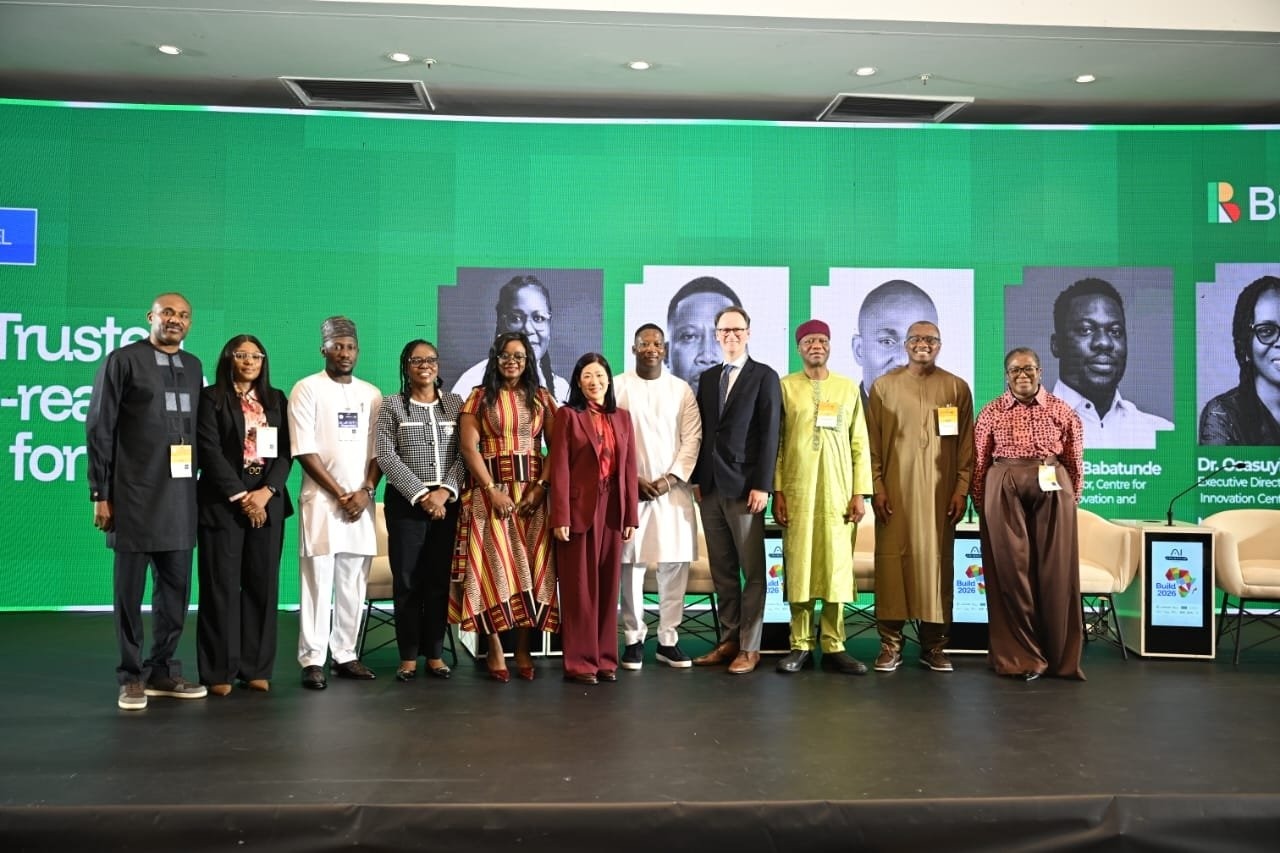
Nigeria has proposed that African countries pool their computing resources so researchers across the continent can run large-scale AI work none could manage alone, Communications Minister Bosun Tijani told the opening of BUILD 2026 in Abuja.
“Nigerian capacity might not be big enough, but over the night, maybe forty-eight hours, we could aggregate this for all of us, and you’ll be able to do what you want to do,” Tijani said in remarks delivered on his behalf by Dr Olubunmi Ajala, national director of the National Centre for Artificial Intelligence and Robotics.
The conference, themed “Building Africa’s Shared Compute and AI Infrastructure,” is built around three priorities: infrastructure, economics and digital sovereignty.
Infrastructure decides who shapes AI
Tijani said “access to computing power, electricity, connectivity and advanced chips will be decisive in determining whether Nigeria and other African countries can shape the future of artificial intelligence rather than remain dependent on technologies developed elsewhere.”
He named electricity, broadband, cloud computing and access to advanced semiconductors as the main constraints, warning that the rapid pace of chip development and global supply shortages could widen Africa’s disadvantage.
He pointed to plans for a Nigeria–Togo data park and expanded fibre connectivity, and said Nigeria had climbed from 103rd to 73rd on the Oxford AI Readiness Index over two years — progress he said would stall without sustained infrastructure investment. “For us to get there, infrastructure is a key point.”
A collective, not just a conference
BUILD 2026 is convened by the Nigeria AI Collective, a community of practice launched in October 2024 that brings together government, regulators, development finance institutions, researchers, investors and companies.
Dr Osasuyi Dirisu, executive director of the Policy Innovation Centre, which hosts the Collective’s secretariat, said the aim is to keep Nigeria’s AI development aligned with the National Artificial Intelligence Strategy. “Our own AI journey could be owned by us, could be locally relevant or globally competitive,” she said.
The Collective is managed by Lagos Business School, Pan-Atlantic University, Data Science Nigeria, the Centre for Journalism, Innovation and Development, and NCAIR, with the Policy Innovation Centre providing coordination. It is supported by Luminate, AI Collaborative, the Ford Foundation and the MacArthur Foundation.
Dirisu said the conference drew applications from innovators across Africa and beyond, alongside research intended to inform policy and investment, and urged participants to keep the collaboration going after the event.