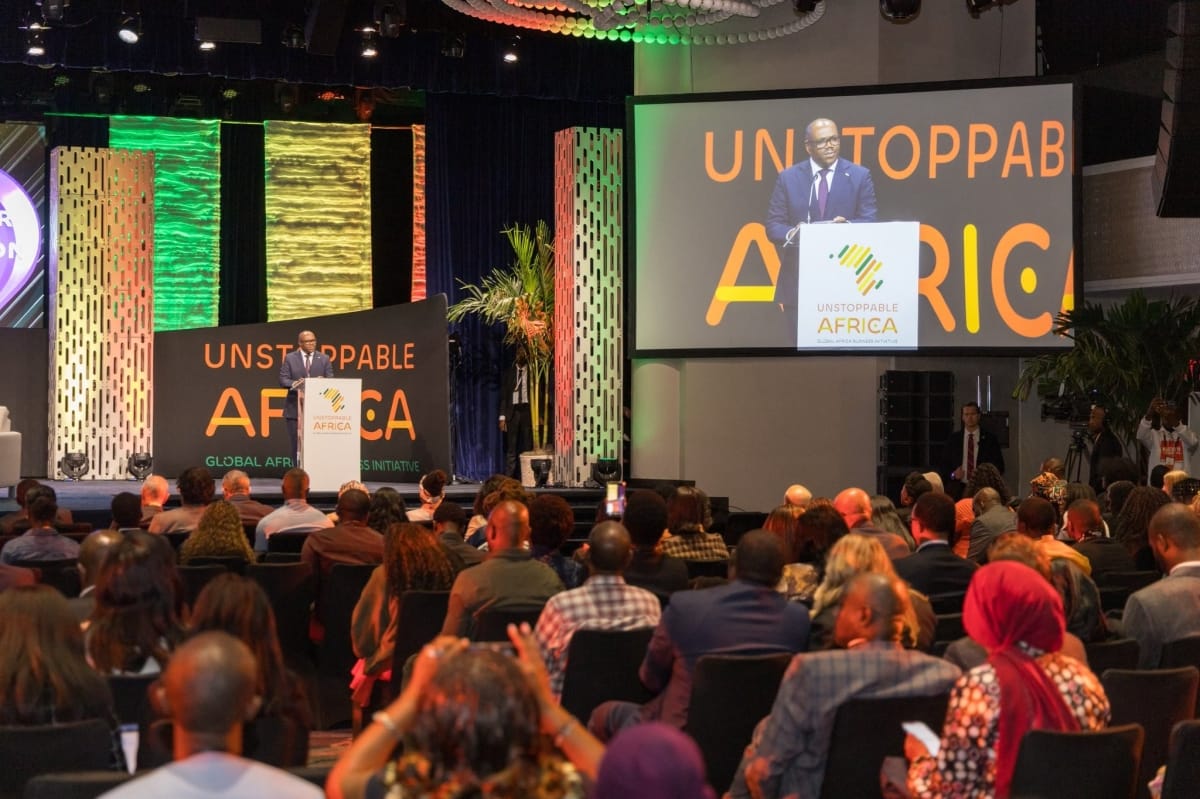
Rwandan Prime Minister Justin Nsengiyumva has set out three questions he says determine whether a country is participating in the AI economy or merely being sold into it — while naming affordable compute and energy as Rwanda’s biggest remaining constraints.
Speaking at Unstoppable Africa 2026 in New York, the flagship event of the African Union and UN-backed Global Africa Business Initiative, Nsengiyumva framed sovereignty as a question of where decisions are made and where value is recorded rather than self-sufficiency.
The test
“Can a state govern the data its own citizens produce? Can its institutions reach the infrastructure they need, on terms they can predict? Can African firms earn margin, or only distribute?”
“If the answer to all three is no, that country is a market, not a participant. I can assure you: Rwanda intends to be an active participant in shaping its AI future.”
That is the most usable sovereignty framework any African leader has put forward this year. Each question is answerable, and the third — margin versus distribution — is the one most sovereignty rhetoric avoids.
It contrasts instructively with the six-dimension definition Microsoft South Africa presented to senior officials at GovTech last week, which was built around controls its own products supply. Nsengiyumva’s test asks who captures the value, which is not a question a vendor framework is designed to answer.
He was explicit that this is not exclusionary. Rwanda’s approach “is not about self-sufficiency or excluding global technology companies.”
The admission
“Affordable compute and energy are still our biggest constraints. And these constraints are precisely why sovereignty matters so much to us.”
A prime minister naming his country’s limitations at an investment showcase during UNGA High-Level Week is not the standard register.
It also puts Rwanda in a different position from some peers. Ethiopia has been positioning for continental AI leadership — an AI university, an AI institute, an innovation hub — while the World Bank advised in August that it concentrate on adoption and adaptation, identifying skills and infrastructure as binding constraints. Lesotho this month became the first country to apply the UN Blueprint for National AI and Data Strategies, working through demand, energy and connectivity before committing to infrastructure.
Nsengiyumva is describing the same order of operations, from a country that has already built more of the base than most.
What Rwanda has built
He cited a national fibre-optic backbone, 4G coverage reaching nearly the entire population, 5G pilots under way, more than 250 digitised government services and a national digital payment platform.
On governance: a National AI Policy, a data protection framework, and a National AI Agency approved in June to drive strategy, research, development and adoption.
“AI cannot thrive on algorithms alone. It needs connectivity to carry it, digital services to put it to work, and rules that people can trust. In Rwanda, we have worked on all three at once.”
No figures were given for compute capacity, energy requirements, or the Agency’s budget and timeline.
The regulatory ask
The most actionable element was a call for cross-border regulatory coordination.
“An application licensed in Rwanda should not have to be argued again in 54 jurisdictions.”
That is the fragmentation problem stated from the supply side. For an AI company in Kigali, the addressable market is 14 million people unless licensing travels — which is why regional harmonisation has become the dominant policy activity on the continent this year. COMESA has run national AI strategy consultations across its 21 member states. The East African Community adopted a Kigali declaration coordinating a regional strategy. Six Francophone West African countries adopted a shared governance framework in July.
Nsengiyumva said Rwanda supports Smart Africa and the Africa AI Council in aligning policy and regulation with continental ambition.
The framing
“In Africa, we are no longer satisfied to be passive consumers of technology. We want to build, adapt, and deploy it at scale, in our own context.”
That formulation has become near-universal among African officials and hyperscaler executives alike. What distinguishes Nsengiyumva’s version is that he attached a test to it.
“We are not asking to be included in someone else’s AI economy. We are building our own, safely, equitably, and responsive to our own needs and opportunities.”
Nsengiyumva is representing President Paul Kagame at this year’s General Assembly. Kagame separately co-chairs the AI for Good Global Commission launched in July, alongside Salesforce chief executive Marc Benioff.