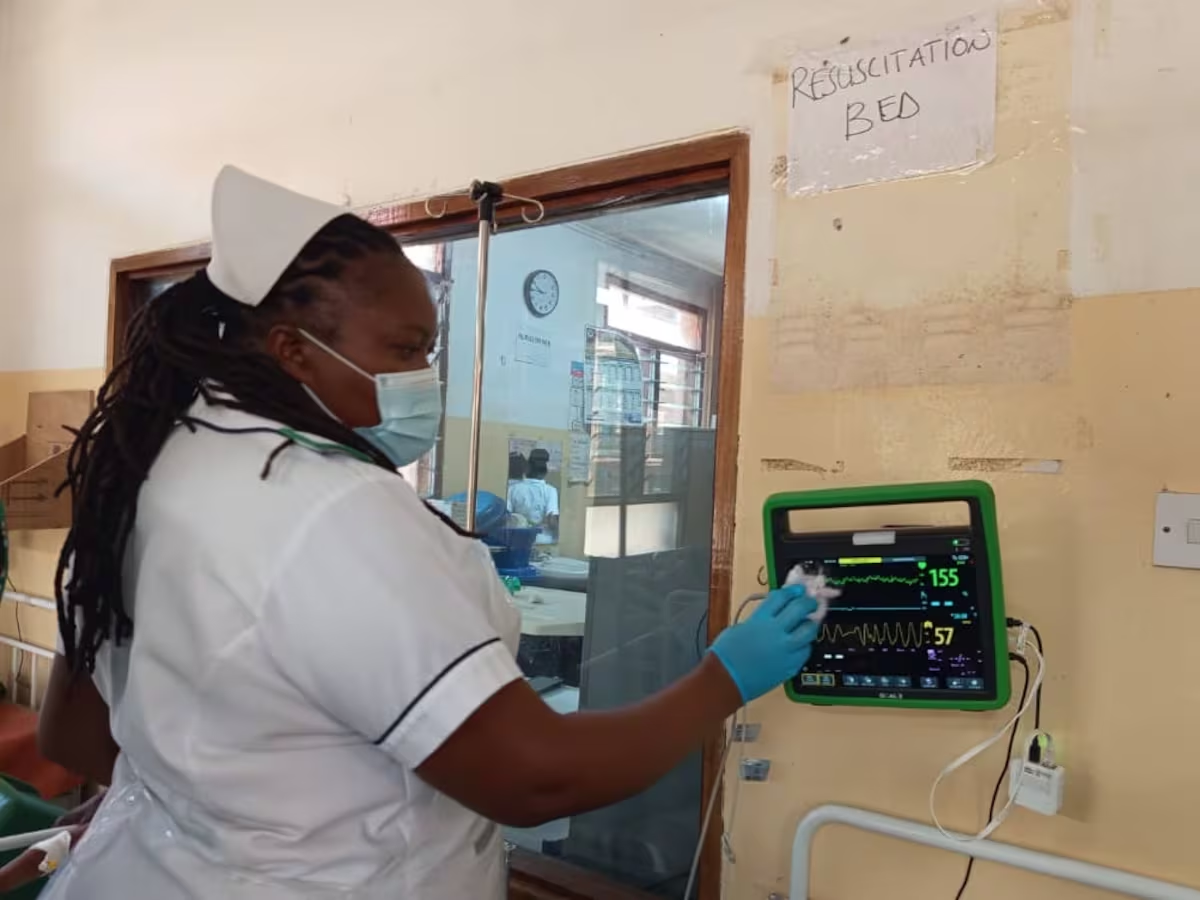
An AI-powered patient monitoring system known as IMPALA is significantly reducing child deaths in Malawi’s under-resourced paediatric wards, with two participating hospitals recording between 40% and 51% fewer deaths over a recent 12-month period.
“Before we could have four deaths in a week or 15 days, but now we record maybe one death,” said Blessings Juma, head of the paediatric ward at Mangochi District Hospital in Malawi. The health worker attributes the change to IMPALA, a monitoring system with AI designed to detect early deterioration in hospitalized patients and reduce child mortality in low-resource clinics.
The project — whose name stands for Innovative Monitoring in Paediatrics in Low-resource Settings — combines bedside monitoring devices with an AI system that can alert medical staff when it detects signs of deterioration. The goal is to help doctors and nurses intervene before an emergency occurs. The need is acute. In 2024, Malawi’s under-five mortality rate was 48.7 deaths per 1,000 live births. That same year, 32,177 children aged under five died, according to estimates from the United Nations Inter-agency Group for Child Mortality Estimation.
Limited funding, lack of facilities and medical supplies, and a severe shortage of health personnel make reducing child deaths a major challenge. Malawi had an estimated 0.1 doctors per 1,000 inhabitants in 2022, according to World Bank data. Spain, by comparison, had 4.3 doctors per 1,000 inhabitants in the same year. The World Health Organization estimates that a ratio of 2.3 skilled health professionals — doctors, nurses and midwives — per 1,000 inhabitants is needed for adequate coverage.
In this context, IMPALA’s backers believe AI can help offset some of those shortcomings. “We started with monitoring systems, but then I thought of adding more value by incorporating artificial intelligence. With the help of this technology, the device can predict illnesses up to three hours before they occur, or alert nursing staff hours before a child’s condition worsens,” said William Nkhono, a Malawian innovator behind the AI patient-monitoring system, speaking by videoconference.
The device allows medical staff to monitor multiple patients in real time, quickly identify those at highest risk and detect complications early. It runs on portable batteries to prevent disconnection during power cuts and is simple to use. Through an intuitive tablet app, the system analyzes vital signs, prioritizes the most urgent cases with alerts and facilitates clinical decision-making.
“Many of the problems that arise in hospitals are due to late detection or not attending to children in time. Thanks to the AI monitors installed at the beds in paediatric wards, the system issues a red signal to alert nurses and prioritise care for the most at-risk children,” Nkhono said. “For example, if oxygen saturation is low, the device sounds an alarm,” said Chifundo Katundu, paediatric clinical assistant at Mangochi District Hospital. The system also makes it easier to record the vital signs of all patients in the paediatric ward — something previously impossible due to scarce resources.
Behind the project is a consortium made up of the Amsterdam Institute for Global Health and Development, Amsterdam University Medical Center, Goal 3, Imperial College London, Kamuzu University of Health Sciences, Malawi University of Business and Applied Sciences, the National eHealth Laboratory and the Training Excellence Unit.
The system has also reduced the workload of medical staff. “Before introducing the monitor, discharge processes could take up to three hours; now they are completed in about 1.8 hours. In addition, we provide continuous training to nursing staff, since there is frequent rotation and every three or four months there are new hires,” Nkhono added.
The IMPALA clinical centre recorded between 40% and 51% fewer deaths in two Malawian hospitals during the 2023–2024 period compared with the equivalent period in 2022–2023, before the monitoring system was introduced. To date, more than 100,000 patients have been admitted to hospital wards where the monitoring system has been implemented. In a separate survey, 91% of the 116 nurses and doctors questioned said their workload and stress levels had decreased.
The founder and chief executive of Goal 3, Niek Versteegde, one of the companies leading the innovation, said the model is reproducible elsewhere. “But to scale it up and integrate it into all other hospitals, we need the government to step in,” he said. The system already operates in Tanzania and Rwanda, and the technology costs between $105 and $208 per life saved. “The investment pays off because hospitals spend less on medicines trying to fix a problem that has already worsened. And for parents, hospital stays are shorter, so they also save a considerable amount of money,” Versteegde said.
“When you invest in this technology, the investment is recovered in lives saved: hospital stays are shortened, facilities need less medical equipment and social costs are reduced,” added IMPALA’s principal investigator Job Calis. The system is currently present in more than 20 hospitals in Malawi, with over 300 monitors installed, and in more than 50 hospitals across sub-Saharan Africa in countries including Tanzania, Rwanda, Kenya, Zimbabwe and Gabon, with more than 800 monitors deployed. “We are continuously expanding our installed base,” Versteegde concluded.