AI-powered eye screening tools are being rolled out in Kenya in an effort to close a widening gap in eye care services, as the country grapples with a chronic shortage of specialists and an estimated 30% of the population in need of care to prevent vision impairment or blindness.
Across Africa, blindness is an escalating crisis. One in every six blind people globally lives on the continent, alongside 26 million others grappling with some degree of visual impairment, according to the World Health Organization. Yet Africa still faces significant gaps in screening and diagnosis — and experts are now turning to artificial intelligence to fill that gap.
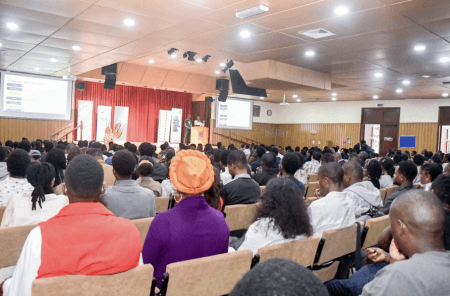
Kenyan Ministry of Health data shows an estimated 9.6 million Kenyans live with refractive errors, while approximately 15,000 children are affected by preventable or treatable vision loss. Speaking during a stakeholder meeting organized by the Women, Youth and Children Development Organization in partnership with HE Vision Group, Daniel Mochere, president of the Optometrist Association of Kenya, said the sector is making progress but remains under strain.
“Five years ago, Kenya had around 150 eye surgeons, fewer than 500 optometrists, and fewer than 200 ophthalmic clinical officers. Today, we have grown to approximately 250 eye surgeons, 1,000 optometrists, and 400 ophthalmic clinical officers — this is progress driven by training institutions, government initiatives, and the work of NGOs. But the challenges remain,” he said.
The shortage is compounded by geography. Most specialists are concentrated in urban areas, even as the heaviest burden falls on rural communities — particularly the elderly, who are among those most vulnerable to vision loss. Many people in remote areas resort to buying medication from local chemists after eye injuries without any proper examination, exposing themselves to further complications. The shortage extends to urban centres too. Anne Wanjiru, coordinator of eye health services in Nairobi County, said that within the 128 facilities in the county, only four offer comprehensive eye care.
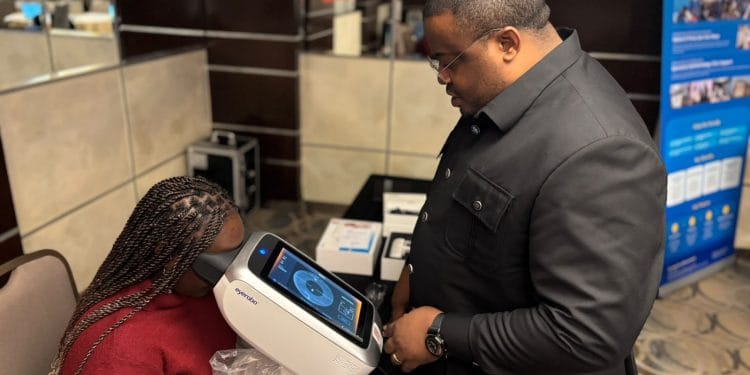
The Africa Ophthalmology Network Foundation, through a partnership with the China-based HE Vision Group, is now rolling out AI screening tools designed to plug that gap. The technologies are designed to be operated by non-specialist health workers and deployed in community-level vision centres. Among the tools presented at the stakeholder meeting were a portable slit lamp that attaches to a mobile phone; a non-mydriatic fundus camera capable of imaging both eyes in under 20 seconds without dilating the patient; the Calidos vision screener, which can deliver objective refraction measurements in under 10 seconds and process up to 500 patients a day; and a 3D frame selector that allows patients to virtually try on eyeglass frames.
Bernard Agbor, CEO of the Africa Ophthalmology Network Foundation, said AI is not intended to replace eye care professionals but to extend their reach and reduce their workload. “Gone are the days where an ophthalmologist or optometrist comes home having seen 40 to 50 patients and is completely exhausted. If that happens every day for the next five or ten years, we will lose those professionals. With AI doing much of the groundwork, clinicians can focus on review, control, and the decisions that truly require their expertise,” he said.
Agbor said the vision centre model is designed to handle up to 75% of community-level needs and will be integrated into the existing healthcare system. The centres will connect to hospital electronic medical records, support telemedicine consultations, and enable referrals and counter-referrals over accessible platforms such as WhatsApp.
Helen Yan of HE Vision Group said the tools have already been rolled out in China, which faces similar shortages. “In China, we only have 20,000 ophthalmologists. It is a huge population. So, we need some innovative devices and platforms to train the people who really want to provide eye care services to the remote areas,” she said. “They serve in the big cities, despite 80 per cent of people being in rural areas, in villages. So, we need such kind of innovation to provide the services to the local people.” The technology has also been launched in Ghana, Cameroon and Tanzania.
The tools, Yan added, can do more than diagnose — they can also flag the early stages of disease. “Early detection of diseases can allow for earlier interventions thus saving costs for patients in the long run,” she said.
Mochere said AI tools can serve a broader role beyond clinical throughput. “The AI-powered tools can supplement our workforce and extend our reach. More importantly, they can serve as platforms for patient education, helping communities understand that the eye is a vital organ requiring proper professional care,” he said.
Sustainability remains a key concern. Agbor noted that many eye care initiatives across the continent collapse once foreign donors withdraw, and called on stakeholders to build systems capable of standing on their own.