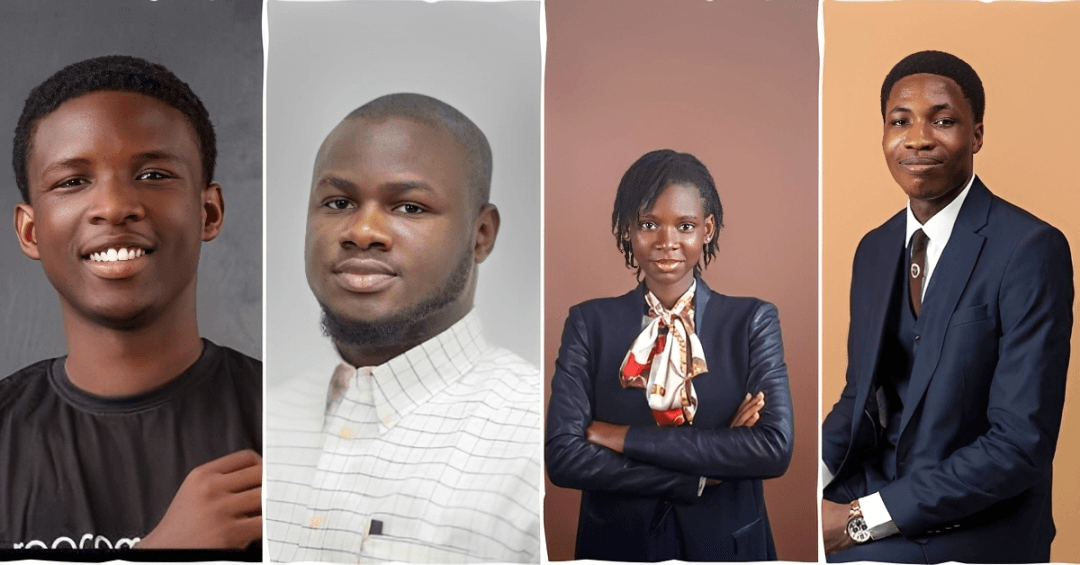
A team of four Nigerian graduates under 25 is building Reedapt, an AI-powered dubbing and real-time multilingual streaming platform aimed at Nollywood filmmakers, churches and African content creators whose work struggles to travel beyond English-speaking audiences.
The startup is the brainchild of Apotierioluwa Owoade, who saw the cost and quality limitations of traditional dubbing firsthand while working at Lagos-based streaming and dubbing firm Aforevo from 2022 to 2023. Translating a film into another language can cost upwards of $500,000 for a full production, according to Owoade — and even at that price, the emotional nuance is often lost. He recalled hearing the Yoruba phrase for “I am pregnant” rendered as “I have a ball” by an existing translation tool.
Owoade brought the idea to his longtime friend David Mac-Asore, a software developer and computer engineering undergraduate at the time. The two had previously collaborated on language projects at Living Faith Church Worldwide International, one of Nigeria’s largest churches, working to bridge English and French-speaking congregations at its Ota headquarters. Mac-Asore brought in former Covenant University classmates Maryann Nnaji and Emmanuel Ibiang, both 2024 graduates. Initially called the “Hagen Project,” the venture was renamed Reedapt in 2025.
Nnaji brought machine learning expertise rooted in earlier research building a sign language-to-speech and text model for her undergraduate thesis. She had encountered a recurring frustration: most existing research on sign language recognition was built around Western contexts rather than Nigerian or African ones. Ibiang, the team’s product engineer, focused on usability. “Can the average Joe use your product without having to be walked through?” he said. “Ease of use of the product — that’s what my role optimises for.” Owoade is described by his teammates as the ideas person.
The startup has signed two enterprise dubbing contracts with a Nollywood gospel producer, with both projects expected to be completed before the end of 2026. Reedapt currently serves more than 200 active users, of whom 94% are individual creators on its consumer tier and 6% are enterprise clients who generate the majority of revenue. The platform charges in dollar-denominated tiers — a free plan offering 60 minutes of usage, a $11-per-month creator plan, and higher tiers at $39 and $99. The team chose dollar pricing deliberately after early experiments with naira pricing undercut credibility with users and investors. The team is targeting 50,000 users by the end of 2026.
Owoade argues that the existing tools in the market were not built with Africa as a priority. “Big Tech isn’t really building with Africa for Africa as a priority,” he said. “Apple released AirPods with a live translation feature, and you see their focus is on languages like English, French, and Spanish. In fact, they seem to prioritise Spanish even more because they’re catering to Latin American users. So, if I had to say it, Nigeria is out of the conversation.”
The data problem for African languages is acute. Training data for the languages Reedapt needs is either scarce or too poor in quality to be useful. Nnaji likened model training to raising a child — if the model is shown only one breed of dog, it will struggle to recognize others. “If the volume of what you’re feeding it is not enough, your model still performs poorly,” she said. The team is currently working with open-source licensed data while building pipelines to collect its own higher-quality training sets.
Reedapt previously used credits from ElevenLabs, one of the biggest names in text-to-speech and dubbing, but is moving toward independence. Before the end of the second quarter of 2026, the team plans to release its first in-house model designed for the specific challenges of African speech: code-switching between English and Yoruba mid-sentence, incantations, spiritual language that should not be translated, and names that existing models routinely mangle.
The infrastructure surrounding the model is as important as the model itself. Before any audio reaches the model, Mac-Asore said, the team runs it through diarization and cleaning processes that separate speakers and strip background noise. Accuracy is tracked using word error rate and supplemented with human evaluation. According to Owoade, Reedapt’s dubbing already performs at the same accuracy level as ElevenLabs for general content and exceeds it on African-specific nuances. The platform includes an editor allowing clients to correct pronunciation errors, and Nollywood producers can upload scripts ahead of dubbing jobs to give the model additional context. Voice cloning is handled entirely in-house.
Building all of this has been costly. Compute costs for training machine learning models are “outrageously pricey,” Nnaji said, and collecting quality data requires controlled environments and specialized recording equipment. The four graduates have bootstrapped Reedapt to the tune of more than $50,000, drawing on cloud credits from service providers and AI model providers to subsidize a significant portion, with the remainder coming out of their own pockets. The startup is now seeking to raise $500,000 to accelerate product development.
For Owoade, the project is deeply personal. He studied foreign languages and literature at university and grew up in school environments where speaking Yoruba — his native language — was treated as an infraction. “They dictated the fact that in most schools, when you spoke Yoruba, it was vernacular. That’s our mother tongue,” he said. Reedapt, in his telling, is a rebuttal to that experience.
By 2026, the team aims for Reedapt to be the leading dubbing and real-time multilingual streaming tool in Africa. Within five years, it plans to expand into India and the Philippines — markets where content creation is booming and creators face similar revenue disadvantages. By 2030, the team is targeting support for 500 languages.
The only thing that would make the founders stop, Owoade said, is if 50,000 customers told them the product was not worth building. So far, none have. And if Reedapt does not survive, Owoade said, he plans to leave an open-source version behind for someone else to carry forward. “That’s how passionate we are about the problem we’re solving,” he said. “It’s not simply a tool; it’s very personal for us, and that’s how we approach the mission at Reedapt.”