This story is a rewrite of "Can Artificial Intelligence stop mass fish deaths on Lake Victoria?" by Davis J. Weddi, produced by SciDev.Net's Sub-Saharan Africa English desk with support from the Pulitzer Center. Original reporting and photography by Davis J. Weddi.
In early February 2026, phones belonging to more than 300 tilapia farmers on Kenya’s Lake Victoria shoreline began vibrating with text messages. An AI-powered underwater monitoring system had detected a dangerous drop in dissolved oxygen below the surface and was pushing urgent SMS alerts to fish farmers at Dunga Beach in Kisumu.
Within hours, farmers coordinated by phone, towed cages into safer waters and moved more than 450 cages of tilapia. The mass kill that had come to define cage farming on Lake Victoria did not happen.
“This is a miracle,” fish farmer Didi Victor told SciDev.Net, showing screenshots of the alert on his phone. The reading, he pointed out, had dropped below 2.0 milligrams per liter — the threshold Dunga farmers had come to fear.
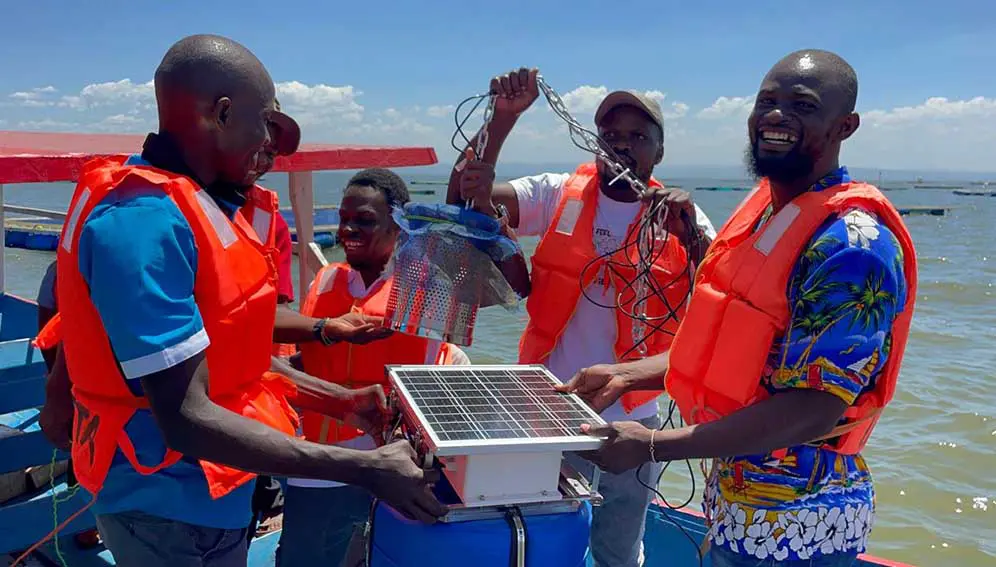
The event marked the first live test of an AI-enabled early warning system built by the Kenya Marine and Fisheries Research Institute (KMFRI) with Nairobi-based ShoShin Innovation Hub. Underwater sensors collect water-quality data and route it through gateways to ShoShin’s cloud servers, where AI models trained on KMFRI’s historical research combined with live sensor readings flag patterns associated with fish kills. Farmers receive simple SMS alerts with prescribed actions — “slow feeding” or “move cages” — designed for use on feature phones on the water.
The stakes are large. Between 2024 and 2025, mass fish deaths at Dunga wiped out close to $1 million in stock, according to ShoShin chief executive Naftal Obwoni. Cage farming on Lake Victoria had promised a new era of commercial aquaculture and income growth for lakeside communities, but repeated, unpredictable kills had left farmers absorbing catastrophic losses on feed, fingerlings, loans and labor. A 2022 KMFRI study found that more than three quarters of Kenya’s fish farmers had reported mortalities on their farms.
KMFRI’s own research points to oxygen depletion as the dominant killer, driven by agricultural runoff that fuels plankton blooms. Plankton produce oxygen during the day but consume it at night, and where fish are densely concentrated in cages, that swing can suffocate them within hours. Chrispine Nyamweya, a senior research scientist and assistant director at KMFRI, said organic matter washed in after heavy rains, uneaten feed and decaying material on the lakebed compound the problem.
Broader pollution pressures make it worse. Dunga Beach sits at the mouths of the Nyando and Kibos rivers, which carry effluent from upstream factories and settlements. Dunga Beach Management Unit vice chairman Maurice Ouko said the early warning system now flags oxygen crashes almost immediately after river discharges, letting local leaders push farmers into deeper water. Kisumu’s own draft Sustainable Waste Management Policy, published in 2025, records that the city generates 400 to 500 tonnes of solid waste daily, 60% to 70% of which is uncollected or improperly disposed of near water bodies.
For ShoShin, the technical bet is on local build. Obwoni said the company assembled much of the platform’s architecture — software, cloud infrastructure and even the circuit boards inside the sensors — in Kenya, in an effort to bring down the cost of deploying Internet of Things technology in places where imported equipment has often been prohibitive. Any sensor bought locally, he said, can plug into ShoShin’s software and start pushing data. The company keeps the farmer-facing interface deliberately simple and reserves the analytical dashboards for scientists and site managers.
Since the February alert, Dunga has recorded no mass fish deaths. KMFRI has identified 15 additional hotspots along the Kenyan side of Lake Victoria for possible rollout, with two more sites expected to go live in the second half of 2026. Nyamweya said farmers will access the alerts free of charge while the government covers data and dissemination costs, with a small subscription contemplated once the network scales.
The event also carries second-order implications. Insurers, historically wary of aquaculture cover because they could not assess causes of loss with confidence, have begun showing interest in the data trail the platform generates — both to understand losses and to price risk. And the system creates evidentiary material for regulators pursuing upstream polluters. Nyamweya framed KMFRI’s role as informational: providing the data, while enforcement sits with the National Environment Management Authority.
The approach is now being tested in a different environment. On Kenya’s coast, ShoShin is working with WorldFish to pilot E-Samaki, a farm-management and advisory tool deployed across mariculture sites in Kilifi and Kwale counties. Farmers use handheld devices to log salinity, pH and temperature; the system flags readings outside optimal ranges. Scientist Esther Wairimu, leading the WorldFish team on the Asia-Africa BlueTech Superhighway project, said one pond-based pilot site earlier this year recorded water temperatures around 47°C to 48°C — extreme for species accustomed to 25°C to 30°C. Farmers, she said, own the resulting data.
Dave Okech, an aquaculture innovator and founder of Kisumu-based Aquarech Ltd, called the system “a welcome development, so long as the AI models give timely, accurate and farmer-friendly alerts,” while flagging questions about the long-term cost of running it.
The Dunga deployment is aligned with Kenya’s National Digital Masterplan (2022–2032), which prioritizes AI-driven government service delivery. It will not, by itself, stop mass fish kills on Lake Victoria: it cannot reverse pollution, regulate the weather or replace the enforcement work that sits with regulators upstream. What it appears to be doing is buying time — the hours between an oxygen crash and a total loss — and giving lakeside communities a data trail they did not have before.