Injini has opened applications for an eight-month AI venture builder aimed at getting education technology built by people who have worked inside African classrooms — with a team structure designed to make that a requirement rather than an aspiration.
Backed by Coefficient Giving, the programme will select 12 pre-formed teams from nine Southern African countries for a five-month build phase producing AI-powered minimum viable products. Five teams then progress to three months of incubation, each receiving $25,000 in equity-free seed funding alongside technical, education and business support.
Who has to be on the team
Teams must cover three roles: a builder who can bring the product to life, a context lead with lived experience or deep understanding of the problem, and a commercial or operations lead. Three or more co-founders are preferred, though smaller or larger teams will be considered.
The context lead requirement is the notable one. It is an attempt to solve, at the point of team formation, a problem that has dogged African EdTech: products designed at a distance from the classrooms they target.
That failure is quantified. When ADQ and the Gates Foundation announced their $40 million AI and EdTech partnership for sub-Saharan Africa in December, the accompanying analysis found more than 93% of EdTech products in low- and middle-income countries are never tested for proof of learning impact, that the region attracts just 2% of global EdTech venture capital, and that only 4% of children consistently use digital learning tools.
Krista Davidson, Injini’s executive director, described the constituency the programme is aimed at. “A teacher who’s watched literacy gaps widen for years, a developer who’s tried to build something for a school and hit a wall, someone who has an idea of why the current tools don’t work and wants to change that.”
The training data argument
Davidson’s sharper point concerns what happens if African teams do not build.
“We’ve spent years engaging with brilliant people across the region who understand education problems intimately, but lack the team, capital, or clear path to build a solution,” she said. “Add to this that Africa is significantly underrepresented in the data training AI tools. If we don’t build our own solutions now, we risk EdTech that simply doesn’t work for African classrooms.”
The evidence supports her. African languages account for less than 0.1% of internet content. The GSMA estimates fewer than 2% of the continent’s languages receive meaningful support from modern AI platforms. Nine of South Africa’s eleven official languages qualify as low-resource for language modelling. An AI tutor that cannot reason in Sesotho or Chichewa is not a tutor for most of the children in the region the programme covers.
The problems it targets
Five themes structure the programme: foundational learning; teacher capacity and classroom support; learner pathways and futures; inclusion and access; and ecosystem and engagement.
Those map onto documented constraints. The World Bank found 89% of 10-year-olds in sub-Saharan Africa cannot read and understand simple text. In South Africa, 81% of Grade 4 learners cannot read for meaning in any language. Thirty-two percent of rural schools in the region lacked regular electricity in 2024 and 68% lacked consistent internet.
Injini names teacher shortages, foundational literacy gaps, linguistic diversity, and connectivity and device affordability as the challenges it wants addressed — an unusually grounded list for a programme brief.
Scale and reach
Applicants must be based in South Africa, Botswana, Eswatini, Lesotho, Malawi, Mozambique, Namibia, Zambia or Zimbabwe. Delivery is mostly virtual, with several mandatory in-person engagements in Johannesburg; travel and accommodation are covered for up to three team members per team.
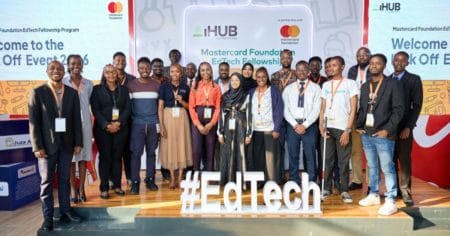
At $125,000 total across five ventures, the capital is modest. The iHUB and Mastercard Foundation EdTech Fellowship, which selected twelve Kenyan startups in July, offers up to $100,000 per company over eighteen months.
Injini’s structure is different in intent. It backs teams that do not yet exist as companies and takes them to a tested product, rather than accelerating startups with traction. The five incubated ventures will spend three months refining products, running user testing, measuring educational impact and building go-to-market strategies and financial models.
Whether $25,000 and eight months produces a venture capable of surviving is an open question. Whether the products work in the classrooms they were designed for is the one the context-lead requirement is meant to answer.