Prosus expects AI-powered general-purpose robots to become commercially viable within a few years at around $20,000 a unit, according to a new position paper from the Naspers-controlled investment group — a bet that South African investors are exposed to through the JSE, even though no African robotics ecosystem appears on the company’s map.
The Amsterdam-listed group said advances in AI, falling hardware prices and better training data are bringing general-purpose robots close to commercial use. At $20,000, it argues, robots become economically attractive across large parts of the global economy.
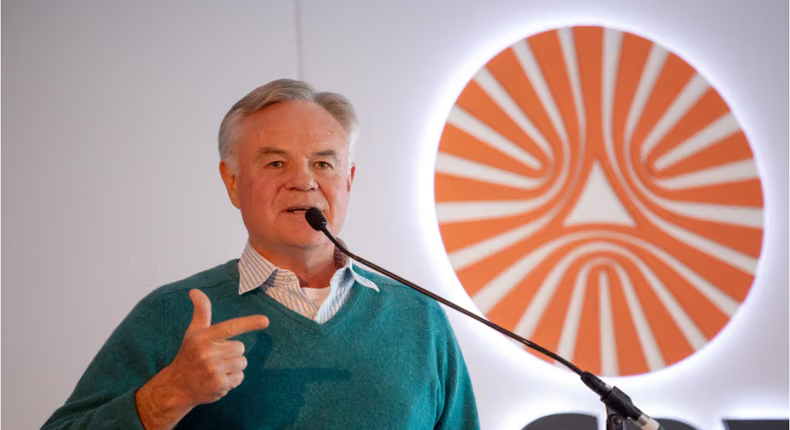
“Robotics is where AI stops living on a screen and starts doing real work in the physical world,” said Thiago Viana de Silva, global head of Prosus Ventures.
The timeline, and the caveats
Prosus compares the current state of robotics with the period immediately before generative AI became commercially useful. It expects the industry to reach a “GPT-3 moment” within about a year — robotic models reliable enough for clearly defined tasks in real workplaces — followed by a “GPT-4 moment” a few years later, when robots could complete simple tasks after instructions given in ordinary language.
It says reliability on narrow tasks has risen from roughly 65% in 2023 to as much as 99.9%, while the volume of data needed to train the systems has fallen.
These are Prosus projections rather than industry consensus, and the company acknowledges that safety, regulation, energy requirements and operation in unpredictable environments remain unresolved. Warehouses, logistics and industrial inspection are expected to adopt first, with consumer services and hospitality following. Construction and healthcare will take longer.
Falling hardware costs are being driven partly by China’s electric vehicle supply chain, where batteries, motors, sensors and actuators produced at scale for cars transfer directly into robots.
The International Federation of Robotics reported 542,000 industrial robots installed globally in 2024, more than double the figure a decade earlier — with Asia accounting for 74% of installations, Europe 16% and the Americas 9%. Africa does not register.
Where Africa sits
Prosus Ventures has invested more than $2.3 billion across over 100 startups in 20 countries since 2015, committing more than $400 million in its 2025 financial year including $88 million in AI businesses. In November 2025 it joined a $50 million Series A for Swiss firm Flexion Robotics, which builds AI systems allowing robots to practise in simulation before operating in the real world. It has now mapped 85 robotics companies across foundation models, hardware, integrated systems, applications and supporting infrastructure — concentrated in the US, Europe and Asia.
The African connection is financial. Naspers, listed and headquartered in South Africa, is Prosus’s majority owner, and Prosus’s results account for almost all of Naspers’s. The group reported ecosystem revenue of $9.7 billion for the year to March 2026, adjusted EBITDA up 84% to $1.3 billion, and free cash flow of $1.5 billion.
That makes this a South African capital markets story before it is an African technology story.
The use cases are real; the economics are the question
iAfrica reported in May on the emerging “physical AI” argument — that after the wave of copilots and chatbots, the more consequential shift is AI perceiving and acting in the physical world. That analysis identified mining and agriculture as Africa’s strongest immediate fits: mining because it combines remote operations, hazardous conditions, high-value assets and constant safety pressure; agriculture because variability in weather, disease and labour intensity leaves room for precision gains.
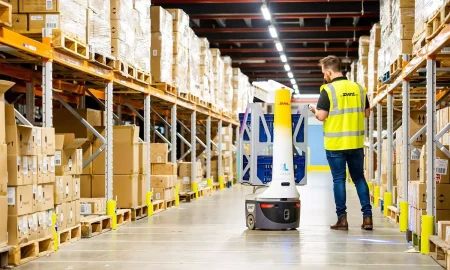
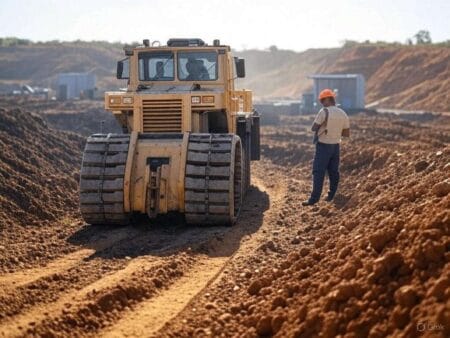
Prosus reaches the same conclusion. In mining, robots could reduce exposure to rockfalls, toxic gases and underground machinery. At ports and warehouses, they could handle cargo movement, inventory and inspection.
But a $20,000 machine remains expensive for most African businesses, and the surrounding costs compound: unreliable electricity, limited maintenance expertise, currency weakness and import duties. PwC found this month that nearly 70% of South African mines rate their AI readiness as poor or very poor, with digital skills — not technology — the binding constraint. A robot that no one can service is a stranded asset.
The employment question
Automation is politically sensitive in a region with the world’s youngest and fastest-growing workforce. The ILO reported this month that youth unemployment in Northern Africa stands at 22.6%, second-highest of any world subregion, and that the middle-skilled roles which traditionally provided entry into work are disappearing.
The framing South African mining executives gave PwC is instructive: they described AI as a revenue-generating exercise rather than a headcount-cutting one, with one saying explicitly that the thinking was not “I could have 40% less employees.” Whether that holds when a general-purpose robot costs $20,000 rather than several hundred thousand is a different question.
The nearer-term African opportunity is likely to sit in work that is dangerous, highly repetitive or hard to staff — rather than in wholesale substitution.