Five artist-engineer teams have presented work from the Artificial Intelligence and African Music project in a day-long showcase at the University of the Witwatersrand, demonstrating how African musical creativity can shape the future of AI on the continent.
The Wits Innovation Centre, in partnership with the Machine Intelligence and Neural Discovery Institute at Wits University, hosted the showcase of a pilot project exploring African applications of AI in music. The five teams represented seven African countries — Cameroon, Nigeria, Ghana, Ethiopia, Kenya, the Democratic Republic of Congo and South Africa — bringing together different disciplines, cultures and creative perspectives.
The discussion took place against the backdrop of major markets in the United States and United Kingdom currently driving the commercial norms of AI in music. In his keynote, U.S.-based philanthropist, music executive and Wits alumnus Charles Goldstuck framed the current environment. While AI has been part of the music experience for around 15 years through machine learning, the launch of tools like ChatGPT shifted attention toward what AI can create. “This isn’t something that’s new, but the generative element has really come to life in the last three and a half years,” Goldstuck said. The music industry, he added, has moved extremely fast through the early cycle of disruption, adoption, litigation and licensing — with African players largely absent from the rooms where the rules are being made.
“One of the interesting things for me as the organiser of this project was the way that the projects were very much orientated towards working with traditional musics, using the power of AI models to preserve and re-create these musics,” said Christo Doherty, professor at the Wits Innovation Centre.
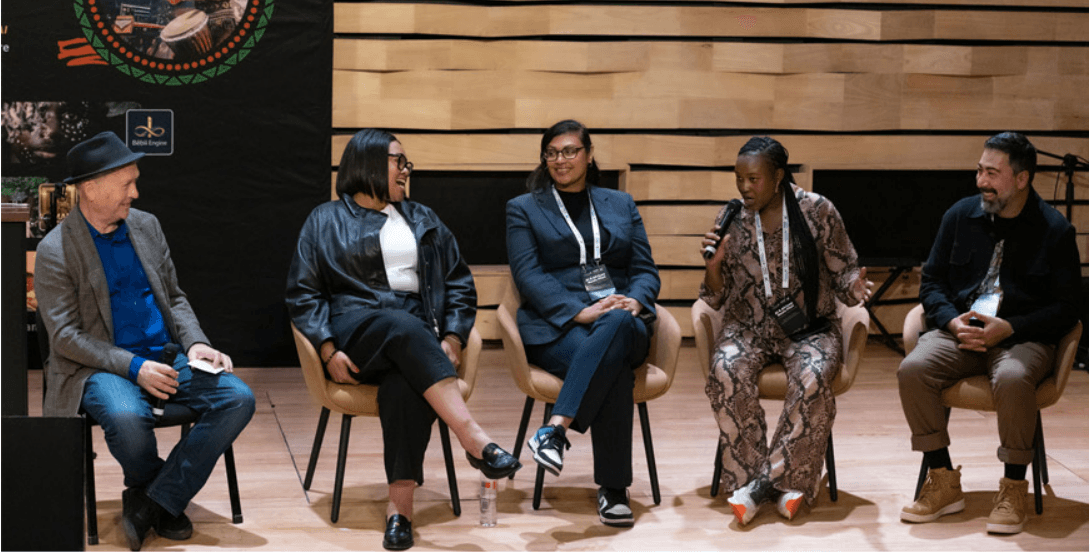
A panel discussion at the showcase brought together music and AI experts to debate how the African music industry can promote creative sovereignty in the AI era. Thando Makhunga, managing director of Downtown Publishing and chair of the Music Publishing Association of South Africa, said the pilot projects reflect long-running conversations about how traditional and indigenous work is handled across the continent. “My feeling on AI and how it’s going to progress is that the more we start to get information from an African context — whether that is language, sounds, tone, context, or tradition — we’ll have a better idea of how to solve for it,” she said.
Ninel Musson, co-founder and CEO of Music Business Lab and founder of independent record label Vth Season, said the challenge is compounded by the fact that most distribution platforms are not African. “Those are outputs that are largely out of our control, until the landscape changes away from more global distribution to local,” she said.
East African music executive Martha Huro acknowledged that the continent is still catching up on previous waves of disruptive technology, including streaming — but framed AI as an opportunity rather than a threat. “Africa, we are still catching up with technology. Now we have AI, and we’ll figure it out!” she said.
Tech entrepreneur Nick Argyros, group CEO of INJOZI Digital, Audio Militia and Got Bot AI, said Africans need to take responsibility for changing the fact that much of the underlying technology is being built elsewhere. “That foundational layer fundamentally needs to change and have African businesses, entrepreneurs and techies create that,” he said, calling it key to scaling opportunities across the continent.
Makhunga added that policymakers must be held accountable for keeping pace with the change. “The pace of our regulators grappling with the change and responding adequately is probably the biggest challenge,” she said, while acknowledging that policymaking must also reflect how fast AI technology is evolving.