Communications and Digital Technologies Minister Solly Malatsi has given the clearest account yet of how South Africa’s draft National AI Policy came to be published with fabricated citations — and set a later deadline for its replacement than his department previously told Parliament.
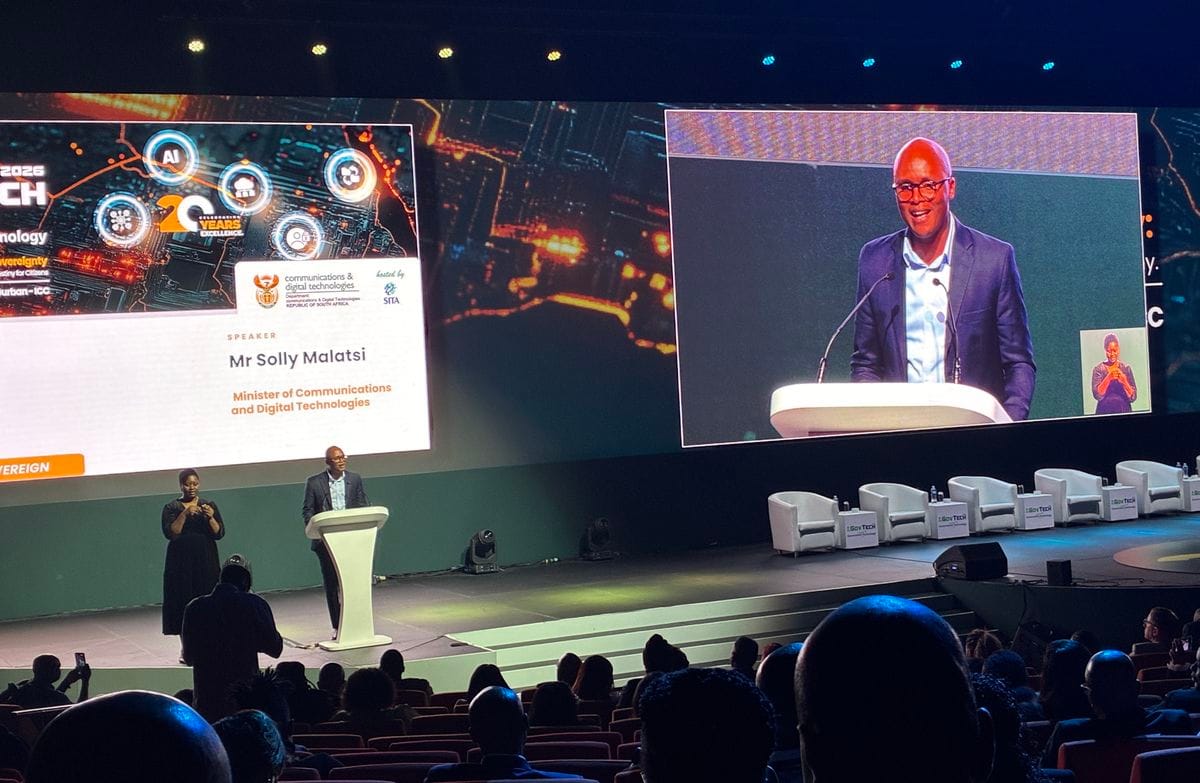
Speaking to Daily Maverick at GovTech 2026 in Durban, Malatsi said his office had scrutinised the substance while assuming the references were sound.
“From my side, we were very, very robust in the feedback to the department from the very first draft,” he said. “And that’s why it was very, very disappointing when the AI hallucinations were discovered.”
The assumption he made is the one worth recording. “We didn’t interrogate the bibliography, because you take it as a given that anyone performing their functions ethically and honestly will not have an instance where there’s undeclared reliance on these technologies.”
The standard he draws from it
Malatsi’s conclusion is not that AI has no place in policy drafting.
“Relying on AI in research, in developing of documents, is only unethical when it’s not declared.”
That is a usable standard, and it arrives from a minister with direct cause to set one. It also lands against evidence that disclosure is rare. UNESCO-backed research published last month found around 58% of South African content creators use generative AI while only 33% consistently disclose it — with interviews showing they fear disclosure damages perceived authenticity.
Daily Maverick applied the standard in the same article, declaring that the interview was transcribed using AI tools.
On lessons, Malatsi was blunt about the cost. “You should never drop your vigilance guard — go to every detail, a comma, and all of that. And it makes the job just increasingly difficult.”
The paradox is hard to miss. A policy designed to mandate human oversight of national AI deployment failed for want of human oversight in its own drafting.
The date has moved
Malatsi put the timeline as follows: “The goal is to ensure that by the end of the financial year [March 2027] … we have a draft AI policy that we can present before Cabinet … and one that can be free from avoidable stains.”
That differs from what the department told Parliament. Acting deputy director-general Jeanette Morwane put the redraft at Cabinet in November 2026, with January 2027 as a consultation fallback — figures iAfrica reported in both the World Bank exclusion piece and the coverage of South Africa’s position on US and Chinese AI stacks.
A shift from November 2026 to March 2027 is at least four months, and the department has not announced it. Worth confirming.
The rewrite is being run through an expert advisory panel chaired by Professor Benjamin Rosman of the Wits Mind Institute. Malatsi said he was “very, very grateful for the calibre of the advisory panel.”
Accountability, and what it cost
Malatsi chose immediate public retraction when the fabrications surfaced.
“When [mistakes] happen, be transparent. Take responsibility and then also deal with how you correct … to ensure that there is no repetition of the same mistakes, and also have credible intervention.”
The consequences were not only domestic. The World Bank’s World Development Report 2026 excluded South Africa from its map of economies with a national AI strategy, citing the April withdrawal directly — while South African institutions, including Malatsi’s own department, appear in the report’s acknowledgements as contributors.
Regulate to enable
On the substance of the coming framework, Malatsi warned against regulating out of anxiety.
“Too often the temptation can be: ‘Yeah, regulate now, regulate everything, regulate everything.’ Don’t use regulation to stifle opportunity. Use regulation to enable sectors to grow. Use regulation to be able to safeguard.”
That is consistent with the posture across South African AI governance. The Financial Sector Conduct Authority said this month it will wait for the Financial Stability Board’s global principles before writing its own rules, favouring principles over prescription.
Sovereignty as development
In his keynote, Malatsi defined digital sovereignty in developmental rather than protectionist terms.
“Digital sovereignty must be treated as more than just security or control issues. It must be viewed as a developmental issue that forms part of our growth plans as a developmental and capable state,” he said, listing state capacity, citizens’ rights, national security, world-class infrastructure, international cooperation and support for businesses of every size.
That last item carries a specific subtext. Malatsi has pushed for alternatives to the 30% historically disadvantaged ownership requirement in ICT licensing — the provision that has kept Starlink out of South Africa — and the framing of sovereignty as enabling businesses “of every size” is read in policy circles as part of that argument.
The definition also sits alongside Microsoft South Africa’s, set out at the same event, which framed sovereignty as six technical dimensions delivered through its sovereign cloud products.
“Technology is not our destiny; our choices are,” Malatsi concluded.
Based on reporting by Daily Maverick.